Tuesday, December 1, 2009

Nectar of the Gods

We had the good fortune of trading some of our pork for beef that friends of ours, Linda and Rick, had recently purchased from an area organic farm. We offered to trade more pork for some of the apple cider they made, when they said there were plenty more apples to pick! So, with our three children, and a few friends of Linda we all went and picked more apples two Sunday's ago. I do not ever recall being able to pick apples this late in Indiana. The trees we picked from were dwarf apple trees that were easy to reach. Some of the trees were absolutely loaded with amazing fruit. The abundance and goodness was almost mind altering, as I ran from variety to variety tasting the fruit. In less than one hour our family alone had picked more than 200 pounds of apples. I felt like this was a little bit of Eden that I was experiencing.


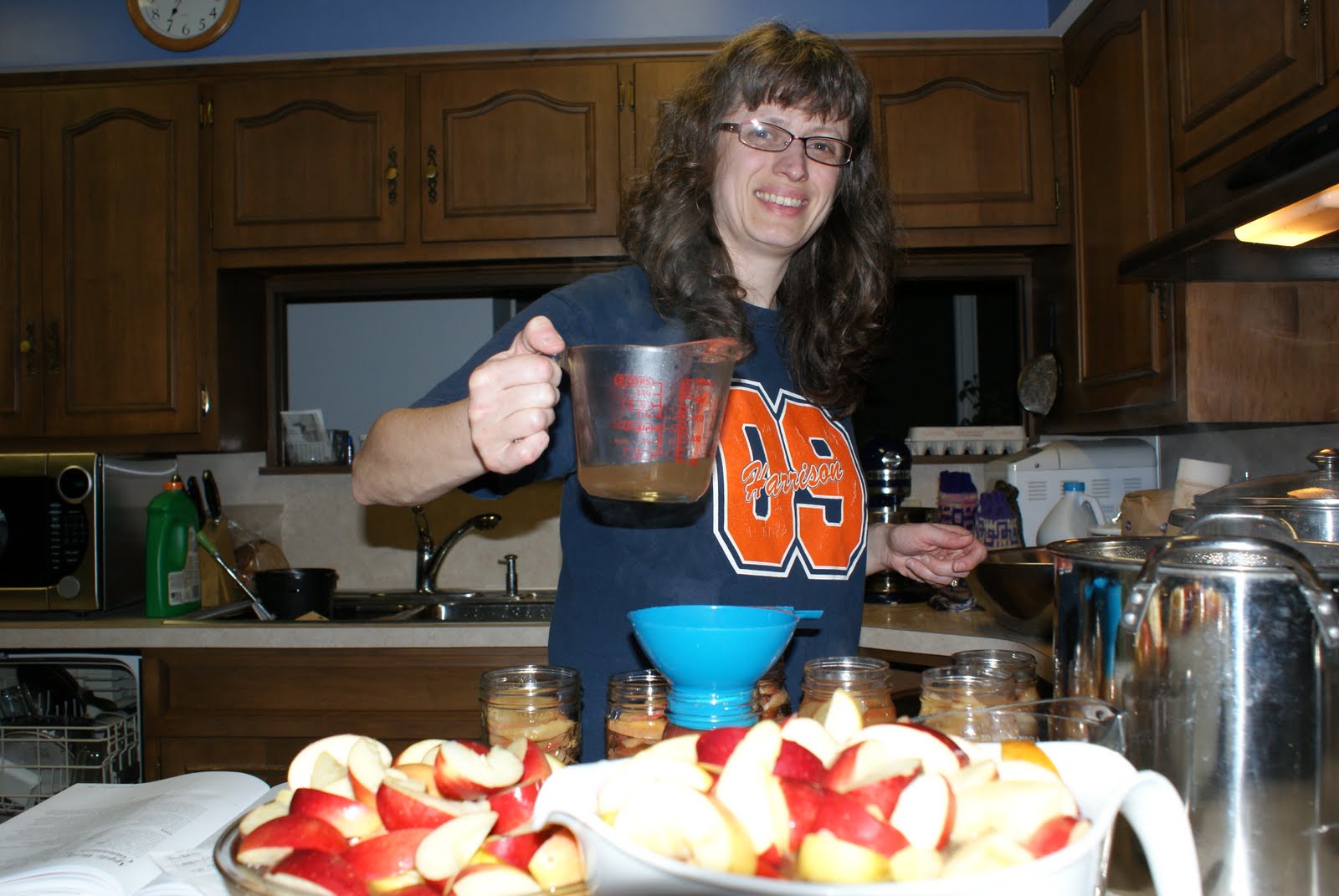
We proceeded on to Rick and Linda's homeplace to process the apples into cider. Making cider was a first for Beth and me. The elegantly built and conceived cider press worked efficiently with only our muscle power...and it was easy to use....as long as I remembered to close off the netting in the bucket and switch out drain pans on time. With a tasting glass, we sampled the various mixes of apples being squeezed into what I like to call the Nectar of the Gods. There is nothing quite like the delectable taste of fresh apple cider. Some batches were very light colored and smooth, and other batches were dark and hearty. We seemed to acheive about 10-11 gallons of cider with one hundred pounds or so of apples. We kept back the rest to process and freeze for apple pies and apple sauce, and a few for just eating through the winter as long as they last...an apple a day does the body good.


Friday, November 20, 2009

Heating Our Home with Wood

This past summer we had our roof re-shingled due to the massive hail storm damage (see blog post from June). While the shingles were off and several plywood sections needed to be replaced, we had the contractors (my cousin's business Triple L contruction) insulate the attic. We brought the insulation level from R19 to over R40. This made a big difference in the energy needs of our house! It has felt cooler in the summer, and retains heat better thus far in the winter. Our windows are another story...single pane from 1969. Beautiful to look out of over the wooded landscape, but terrible in terms of energy efficiency.

In addition to the extra insulation, we also started to seriously consider using wood to help heat our home. Propane prices have increased greatly, along with all other fossil fuel prices. I don't think we'll ever see fossil fuel prices go back down. They are certain to increase greatly over time. The total price we pay now for LP each heating season has tripled in the 8 years we've been in the house! This, despite keeping nighttime temps quite low, and daytime temps low when we are not in the home during winter week days. We had installed a programmable thermostat which made things very convenient. However, we do live in a woods and do have some access to dead trees we could consider for heating our home.


Our ancient fireplace insert is quite small and not very efficient. It adds some ambiance and does help warm part of the living room area. After researching outdoor wood furnaces that can heat the home and the water we would use, we decided the $10,000 + investment was not the best choice at this time. We found an indoor wood burning furnace that will integrate with our current gas furnace for the best of all worlds. It is also EPA approved for efficiency (up 76%) and low emissions. We spent a lot of time working on the installation...and it still is not completely electrically installed. Beth has had visions of me as the father on The Christmas Story, going to the basement to kick, scream, and cuss out the furnace on a daily basis. The directions are very vague, and looks like we'll need to hire an expert to get it compeltely hooked up and running properly. It's really, really hard for me to admit defeat. But, I think we need to call in an expert before I get socked to death.
This has not deterred me from USING the wood furnace. Other than one day where the gas furnace malfunctioned and continously heated the house to about 85 degrees, we have not used any lp gas this season. The wood furnace does take more oversight, but I've been really impressed by how much heat and how long it will burn a load of wood.


The other aspect of this is that I need to get out there and cut, haul, and split wood a LOT more. this is a lot of time and muscle required, but also is good honest work (and might help keep me in shape). It feels good to know I can gather the necessary resource for heating our home locally. The trees are a renewable source of energy, as long as we harvest respectfully and utlize this sustainable source responsibly. On the economic side, I've estimated we'll save over $1,000 dollars a heating season (typically Nov - April) with the wood furnace. This is a big savings, and will basically pay for the indoor wood furnace in three years! Beyond three years, the savings will accrue.


I know not everyone can heat with wood, but it is an option that may end up being one of the better ways we can locally source our energy for heat. One of the best things we can do in current times is to re-forest the landscape. Trees do an incredible number of functions to made ecosystems healthier and more stable, and provide many useable products in the future. It used to be that a nation's wealth was accounted for based on the health and spread of its forests. With the vast increase in wood burning technology and efficiency, and if you have access to a wood lot, and research what you are doing, it can be economically and environmentally sound.

Friday, November 6, 2009

Our Pork Chops vs. Their Pork Chops Part II

So, What gives? How can Payless sell pork chops for half the price that it takes me to raise mine from scratch? It has a lot to do with the cheap food policy promoted by the federal government and agribusiness corporations, cheap but wildly potent fossil fuels, and the dietary choices we each make.

Industrial U.S. agriculture produces the pork chops you can purchase at most grocery stores such as Payless. And, it produces those pork chops on a wide scale based on intensive use of non-renewable resources such as fossil fuel, minerals, and metals coupled with huge government payment programs to industrial agriculture. $11.3 Billion for commodity subsidies in 2006 alone. (An agricultural commodity, such as pork, is usually a food product produced on a large market scale.) This figure does not include "disaster relief payments or conservation ag payments...both of which would be unnecessary in a sustainable food production system. Some estimates show that the average U.S. taxpayer pays out around $300 annually toward agricultural subsidies to Uncle Sam...which then is distributed to the agribusiness giants. This amounts to $600 for most families per year.

Humans have been practicing agriculture for at least 10,000 years, but it is only in the last 60 or so years that heavy industrialization has occurred. So much so, that farmers are extremely dependent on synthetic chemical fertilizers, pesticides, and fossil-fuel powered machinery. As a result yields have greatly increased during this period of time, along with an increasing population of mouths to feed. Yet, the overall efficiency of production has sharply decreased when considering the amount of energy used in the industrial system. Scientists estimate that the industrial food producing system uses from 3 to 10 times as much energy as it produces. This means for every kilocalorie of food energy produced 3 to 10 kilocalories of energy were necessary to produce it and get it to the stores, where we drive to purchase it. (The ratio is much worse 35:1 for beef produced in feedlots compared with grains) How long can we keep this up?

What does this have to do with the price of pork chops in Payless? In order to keep the price of those pork chops low, in spite of the very unsustainable use of energy and non-renewable resources, our government pays out big bucks to keep this industrial system propped up and functioning. Who pays for it? You do. I do. We all do. And our children will pay dearly if we don't get it turned around soon. Although the pork chops at Payless were going for 97 cents a pound...you don't see the hidden costs behind those pork chops on the sticker price. If you account for all of the hidden costs they should cost us at least $6-8 a pound.

We very much need a level playing field when it comes to food production politics. If we had such an environment, I bet we would see a rapid move to sustainable food production. A system where we retain freedom of choice and quantity of foods we eat, but we pay the appropriate price for the food with the heretofore hidden costs included in the sticker price. My guess is that we would likely eat fewer pork chops and meat overall, but that when we do purchase foods they would be coming from local growers using sustainable practices. This would have the desired effect of creating more niches for local jobs, our dollars spent would circulate within the local economy strengthening our communities, providing healthier food and healthier people.

Somehow we the people must get our elected officials to support real change in food production policies. But, in the meantime, we can choose whenever possible to eat food produced locally...even though it means we pay out of pocket twice....once for the food and once for commodity subsidies of the food we are not eating. There should be no "cheap food policy" because there really is no free lunch.

Oh, "our" pork chops are pretty darn tasty! But I'm hoping to find a way to feed a pig or two more sustainably in the future such that the ratio of energy in to energy produced is even more favorable.


Saturday, October 31, 2009

Our Pork Chops vs. Their Pork Chops Part I

Our two pigs remained in their woodland pigpen until I opened their gate last Monday evening. They both walked right out, up a small ramp and onto an open air trailer without so much as a nudge from me. However, in preparing for loading the pigs I had jumped across the fence into their pen to retrieve a feed pan. I simply ran and sailed right over the fence into the mud. I grabbed the feed pan and made the same leap back over the fence, but my boots were sucked back somewhat by the mud. Once airborn I noticed that the ground was much lower on the pigs' side of the fence. I realized that I was not going to clear the fence. As gravity pulled my 180 some pounds down my boots caught the fencef violently, my pant leg ripped open on the metal fence post, jabbing into my leg. I hit the muddy ground and many protruding tree roots with my ribs looking every bit like a world wrestling federation champ free-falling onto a hapless victim. Once I verifed that nothing was broken my only thought was "Dang! I sure am glad I'm hidden from view back here in the woods and no one saw me do that silly-assed dive over the fence." What I didn't know was that my dear wife was peering down at me from the screen room on our house at just that moment...apparently quite impressed with my pig loading skills. Later she said, "I had never seen anyone jump straight up in the air like that. I thought it must be some pig whispering leap to get them to go out the gate and onto the trailer."


All things considered, I was quite happy that the pigs were safely on the trailer. The day before we had just finished eating our first ever homemade donuts. If you've never tasted homemade donuts you are really missing out (picture below). I saved two glazed donuts and apple peelings to serve to the pigs as dessert after their final meal. Hams and Bacon had led quite good lives at our homestead, but I wanted to give them thanks for giving their lives so that we can eat this next year.


Tuesday morning Beth and I rose from bed extra early and drove the pigs to the local butcher in Lafayette. It was still dark out when they walked into the abbatoir and across the scales. One bystander's mouth dropped open when he saw how large the pigs were...he bet me that the one was a 300 pounder! The man weighing the pigs gave us the weigh slips. Hams weighed in at 275. Bacon weighed in at 245 (an average weight for a market pig is 230lbs...so the 275 pounder is a heavy weight). They had started out life on our homestead at a mere 25 lbs each (see picture above) The total amount of actual pork, minus all of the inedibles, was a grand total of 370.8 pounds! That, my friends, is a lot of pork. We brought home the fresh pork cuts today. The hams, bacon slices, and other cuts that will be cured will take another week.


Although we have not fixed pork chops yet, we will soon. First on the menu will be a stir fry using small bites of pork steak along with greens, onions, and cabbage from our CSA basket. However, it was time to calculate just how much our pork chops cost us in dollars and cents. Here is how it came out:


Pigs $40 each = $80
Straw = $7.50
Nipple waterer = $5.00
Feed (1,300lbs) = $234.67
gas/hauling = $20
Butcher/processing = $326.91


Our pork chops cost us $1.82 per pound.


I cannot yet vouch for any taste differences between our pork chops and those that you can get at the local supermarket, but we have a hunch that our pork chops will compare with the natural raised pork chops from the farmers market. So when we compare our cost of $1.82 a pound with the $4.75 per pound price at the farmer's market, we do pretty well. But, pork chops can be had in our town for less, I found out. Much less! Payless has a "loss leader" on pork chops this week selling at a mere 97 cents a pound. These were their "mixed" chops...of mediocre quality. I know because I've had them before. Their better chops are selling at $1.69 a pound. Still less than ours cost us to raise, despite the fact that we had to provide daily care for our pigs, haul feed and water for five months, pay the butcher, while taking ownership for growing our own food. Now, Marsh supermarket, just down the road from Payless, is selling their good quality pork chops for $3.99 a pound which makes me feel better. More than double ours. Which makes me scratch my head a bit, too.


What gives? how can Payless sell pork chops for half the price that it takes me to raise mine from scratch? And, how can the good folks at the farmer's market command more than four times the amount that Payless gets for theirs?


It has a lot to do with the cheap food policy promoted by the federal government and agribusiness corporations, cheap but wildly potent fossil fuels, and the dietary choices we each make. At this juncture, I'm going to taste our pork before extolling any further on these issues. Be back soon!

Friday, October 23, 2009

Pigs Escape! or How I got my Pig Mojo Back

This past spring we decided to add to our managerie of useful animals that help feed us by bringing home two piglets to our forest garden homestead. The idea was to raise our own pigs for pork. We would give them a good life in a modest pen in the forest, next to our chickens. They've been eating scraps from our table and excess garden produce, but mostly standard corn and soybean mixture feed. I happened to be home in the afternoon and not at the office when I received a call from our son, "hey, [the neighbor boy] just called me and said he got off the school bus and he was greeted at his house by pigs in his yard." I thought this must be some kind of joke, because I had checked on OUR pigs just two hours previously and they were lounging in their pen without a care in the world. This certainly had to be someone else's pigs. Yeah, right! No one in several miles of our house has a pig. Isn't it strange how our brains go into denial when faced with known, but terrible facts.

I tried to keep my cool as I walked (in a marathon walking sort of way) down the hill from our house to the pig pen. No pigs. I carefully inspected the pen, as if I really expected the pigs to simply sprout back up out of the ground and reappear. The fence in one corner was mangled badly with deep rooted out areas beneath it. It seemed such a small opening for such large animals to fit through. Unbelievable! How did this happen! I began to feel a slight panic feeling. A strange horror film flitted through my mind's eye. The frames of the film blurred by...our almost fully grown pigs running pel-mel, but unknowingly, toward brutal death trying to cross the highway in front of our subdivision to reach the corn field on the other side. The film slowed down and I see my pigs colliding with a BMW. I zoom in. I see the BMW is driven by a vegan suit and tie wearing CEO who's brother happens to be the chair of the local zoning board. The film's trailer ends with "Man jailed for pig neglect, disturbing the peace, and maintaining a common nuisance of the farmyard variety". The short film fades with an interview clip of our most skeptical neighbor..."the chickens we eventually tolerated, but this! they should throw away the keys." Now fully in panic mode, I phoned my wife pleading for assistance if she wouldn't mind closing her shop to come and herd pigs. What better way to spend the lovely afternoon.


Now sweating and in full panic mode, I ran down to the neighbor's house where sure enough our pigs were casually inspecting a whole new world known as the neighbor's front yard (see photo above taken by neighbor boy). One problem is that this yard was a quarter of a mile from our house. I ran back home, jumped in the truck, hooked up a small trailer I had just bargain purchased a few weeks before and headed back down the road. "How will I get these pigs back" was all I could wonder. Two neighbor boys were gracious enough to help me try to herd these porcine escapees into the trailer. No way were they going near the trailer. At this juncture, let's put this into context. We live in a subdivision. A unique, old, very forested subdivision, but still a subdivision none-the-less. I have neighbors who do not appreciate our chickens...and the clock was reading about 4pm...pretty soon people would be arriving back home from work. It was hard not to feel panic at the prospect of these dignified professionals arriving home at the site of pigs running amok in their neighborhood. I thought, "what in holy hell am I going to do?"


Then the neighbor boys, who were meanwhile pulling out their phone cameras and snapping shots to text and send to friends, family, and the police, started herding the pigs down the road back to our place. I stared with some astonishment, and little by little we got the two pigs in a narrow strip of land, heavy with briers and poison ivy, that lay between the creek and the road. We gently urged them on, me whistling and cooing as they curiously rooted and sampled every species of plant as they went. Then at the half-way point back down the road to our house I got my pig mojo back (side story: I raised various breeds of pigs on my parents small farm from age 11 through age 18, winning many awards, including best showman....which involves a very high level of professional knack with steering a pig exactly where you want it to go with the grace normally given to the dance floor - you might think wow, when would that skill ever come in handy, but...) Here I was herding two escaped nearly fully grown porcines down a subdivision road. Carefully navigating the flight distance between me and the two pigs, at an angle which would slowly move them in the right trajectory back toward their pen, we were only 30 feet from the gate. Elizabeth arrived in the Rav...deftly swinging the car at an angle to the road to block any hasty retreat of these swine...for a split second the Toyota Rav was a black suburban with tinted windows. My wife an FBI agent dressed undercover in black leather, sliding the vehicle 180 degrees blocking any escape. A sting operation, making sure these pigs would serve out their days where they belonged...in the pen! Meanwhile back at the ranch, the neighbor boy opened the gate, stepped aside, and sweet jesus both pigs languidly found their way back in to their lovely mud and straw covered pen.


They seemed relieved. I was overjoyed, but in shock. Pig mojo back. Ham and bacon preserved for future meals. Perhaps at least a couple neighbors none the aware. My wife said, "You are a pig whisperer," but wondered if the expense of the feed and the trouble to keep these pigs was worth it. I'll let you know in two weeks when we have pork chops covered with baked apples.

Wednesday, August 19, 2009

The Harvest

As summer tilts toward autumn, our small gardens have done well, with little work on our part, providing us with respectable harvests of beets, cucumbers, tomatoes, green beans, peppers, squash, carrots, and several meals of sweet corn and broccoli. We will soon harvest potatoes from the "tator tires".


We have really enjoyed simply walking up to the garden and gathering what is there. I thank the soil, the rain, the sun that energizes it all. We put a fairly hasty (due to my looming surgery), but somewhat planned effort, into two small gardens this spring. One at the Purdue Village Gardens and the other at our home of one small raised bed, a small patch of experimental sweet corn, several tator tires and hills, and two summer squash plants.


The sweet corn was a trial and error plot at our home site. The plot only receives about 6 or so hours of sunlight a day. Not really enough to have healthy corn production. But, we did get a number of decent and delectable ears. Our garden at Purdue also grew sweet corn, slightly better than at our forest garden, but not much better. Corn needs a lot of nutrients to produce well. But the buttery, sugary taste of sweet corn is worth the wait and the effort. Fresh picked is the best there is!


After good soil and proper water amounts, the keys are plant spacing and mulching...with early weeding as needed. After the first several weeks of work, we've really not spent much time at all on maintenance. Most of it has been in harvesting, cooking, preserving, and enjoying! This photo shows my bias toward "natural gardening"...but I've actually gone to a more balanced approach with less chaotic wild growth of native plants and more space for sun and garden plants. Hey, it only took me 8 years to lighten up a bit.


Tomato-Cucumber Salad. Add dill, vinegar, salt. Simply Cooling and Tasty.


Canning beans and dilly beans! A taste of the summer will be hidden away for a winter's day.


Earthy Beets....and the pigs loved the tops...Brent did too. We pickled these.


And what to do with the squash after too many stir fry dishes and zucchini bread? Make squash brownies and cookies. Ok, they do taste like a "healthy" cookie. But, they were fun to try out. Actually, most all the cookies were consumed by our kids and me.


Brent sampling squash cookie.
Beth with grated summer squash for brownies.


Wednesday, June 10, 2009

Apocalyptic Hail

There are so many cool things we could be blogging about. To whit:

Our trip to French Lick wherein a bird flew in the room of our B&B
Installing a new Queen Bee in our hive
Getting two little pigs
Attending Brent's permaculture course at Purdue
Looking for dandelions to make wine but finding only a few...

But June 1st we were pummeled with hail like I have never seen before. It lasted at least 10 minutes, maybe 15. When it was over this was what the steps to our house looked like:


The upshot of it all is that our camper is totaled, our car was close to being totaled (and thank goodness we had full coverage on both!), and our roof is shot. We're in the process of negotiating with two different insurance companies for the home & the vehicles and it is taking all of our time. Maybe in the end we'll have a new roof but it hasn't been a lot of fun.

AND the carpet we chose to have installed before Brent's surgery is back ordered and they want to subsitute with something we haven't even seen yet. I guess anything would be better than "Essence of Dog Barf" that we have now...trust me, you don't WANT a picture of that.

So hopefully we'll pop back in after Brent's surgery when we have lots of time to tell you about our adventures.